What Did Medicaid Do? Re-examining the Oregon Health Insurance Experiment
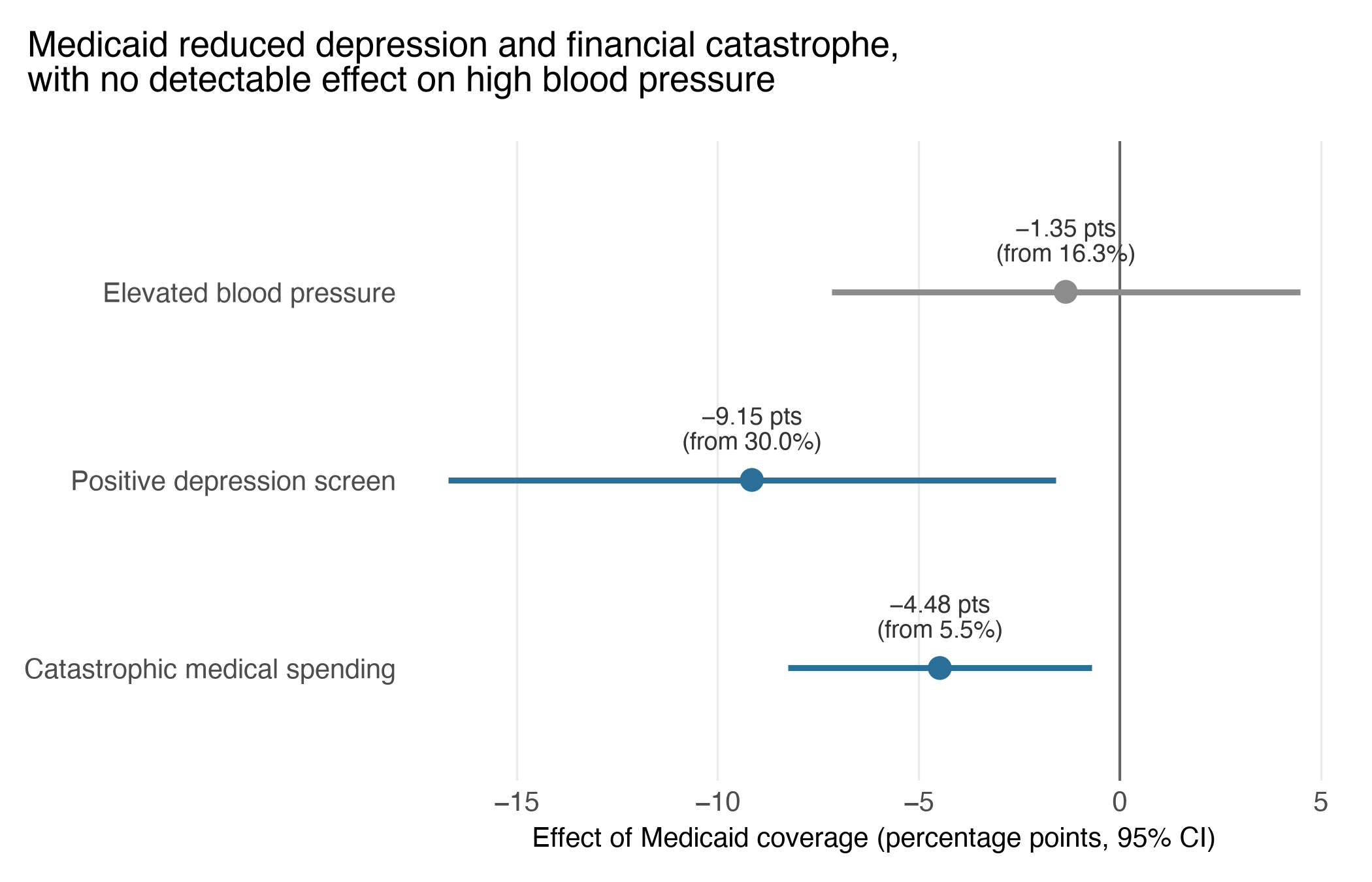
In 2008, Oregon expanded Medicaid by lottery, creating one of the few randomized tests of what health insurance does. The study’s best-known paper (Baicker et al. 2013, New England Journal of Medicine) found that Medicaid reduced depression and catastrophic medical spending but had no detectable effect on blood pressure, and it has been widely cited in debates over health policy.
I rebuilt that analysis from the public-use data, reproduced its headline estimates, and asked how well the evidence supports the way the results are described.
Summary
- Reproduced the published results in Python (pandas, statsmodels, linearmodels), with a parallel implementation in R that matches the Python results on every table.
- Followed the original design: lottery-based instrumental variables, survey weights, and household-clustered standard errors.
- Checked the experiment: response rates and covariate balance between lottery winners and losers.
- Extended the analysis with power calculations, minimum detectable effects, and checks of specific claims in the paper.
What I found
Some of the paper’s summary claims go further than its evidence.
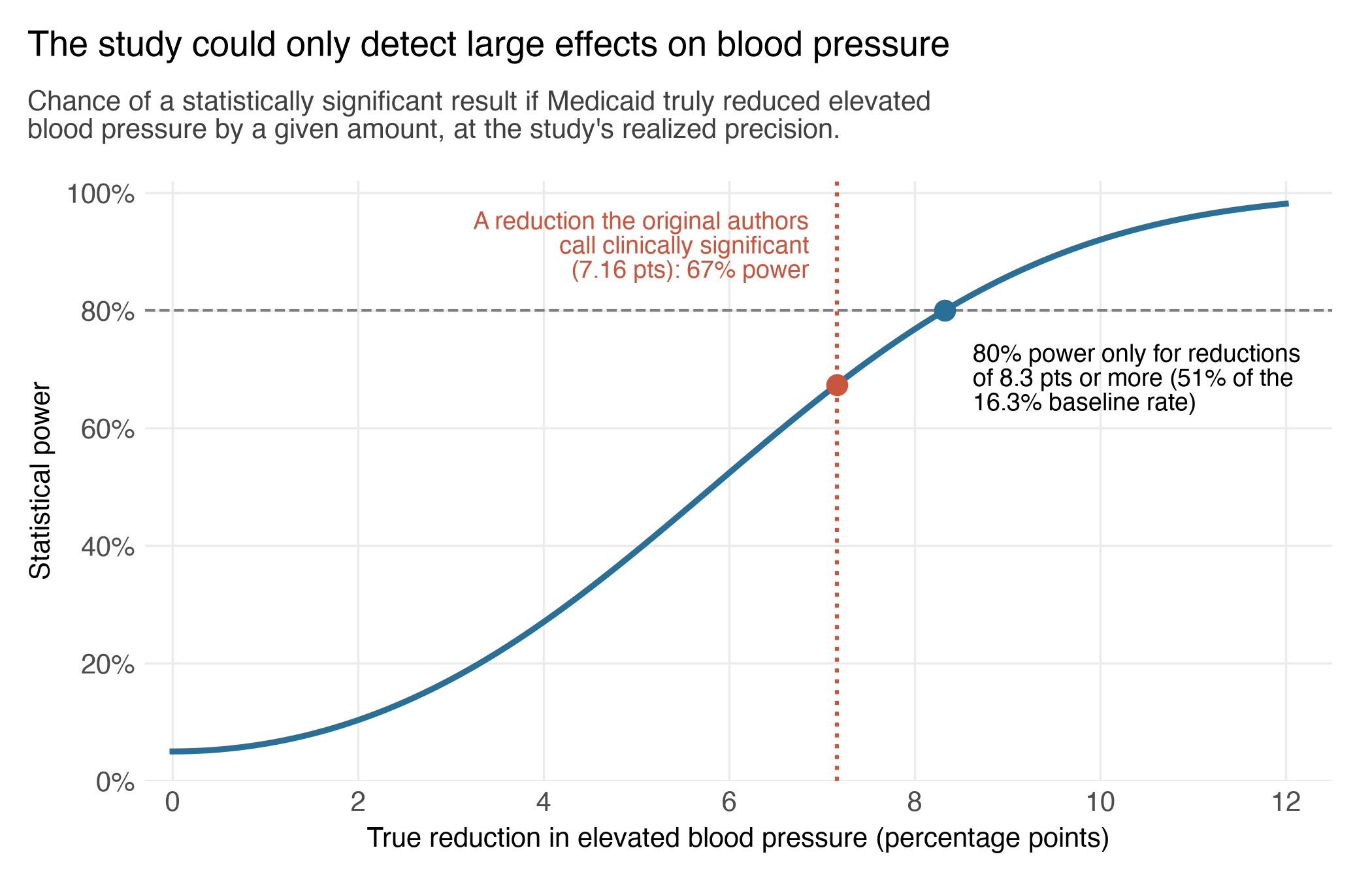
- The blood pressure “null” can’t tell no effect from a meaningful one. The study had a 67% chance of detecting a reduction the authors themselves call clinically significant. Its 95% confidence interval runs from a 44% reduction to a 27% increase.
- The positive findings are stated more precisely than the data allow. “Nearly eliminated” catastrophic spending describes a point estimate whose interval is consistent with a reduction as small as 13%.
- The paper misstates its own definition of elevated blood pressure. The published results use systolic or diastolic thresholds; the table footnote says and. Under the stated definition the control-group rate would be 7.0%, not 16.3%.
- Covariate adjustment can’t recover the lost precision. Pre-lottery characteristics shrink standard errors by only about 1%.
Takeaways
A null result from an underpowered study is not evidence of no effect, and a significant result is not evidence of an effect as large as its point estimate.
Read the full report for the full methods, balance checks, and replication details.